Do Libertarians Attract Bears? We Checked 222 New Hampshire Towns
Does liberty attract bears? A Libertarian Walks Into a Bear made that implication into a marketable story. We decided to check the numbers.
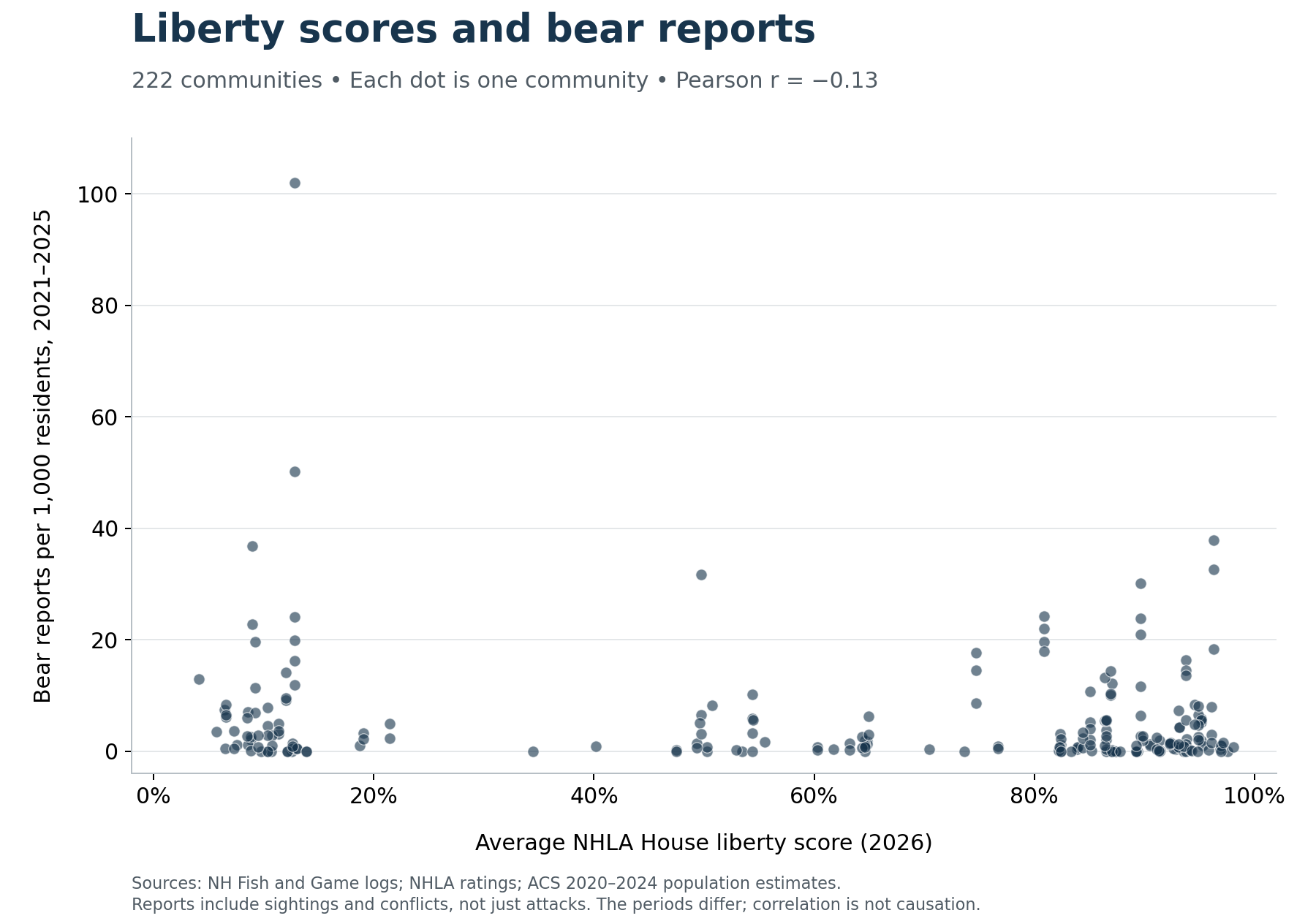
Across five years of New Hampshire Fish and Game records and 222 towns, higher legislative liberty scores from the New Hampshire Liberty Alliance (NHLA) showed no strong association with more bear reports. Apparently, the bears haven’t been reading the NHLA scorecards.
The scores measure representatives’ legislative votes, not residents’ beliefs. The 2021–2025 records test a statewide association, not the book’s account of earlier events in Grafton.
What the statewide records show
Fish and Game supplied five years of records containing 2,496 statewide reports from 2021 through 2025. They include sightings, agricultural and general conflicts, public-safety concerns, feeding reports, and reports involving sick or injured bears. The 2,496 entries are not a count of bear attacks.
The largest five-year totals were Berlin with 114, Moultonborough with 91, Littleton with 88, Lancaster with 78, and Conway with 75.
Do towns with higher liberty scores report more bear conflicts?
We matched bear reports to town averages derived from the NHLA’s 2026 House Liberty Ratings. The comparison included 222 municipalities, of which 205 had complete ratings coverage and 17 had partial coverage.
The finding held whether we compared total reports or reports per 1,000 residents. This is a comparison of legislative voting records and reported wildlife encounters; it does not establish that liberty causes or prevents bear conflicts.
About that book…
Matthew Hongoltz-Hetling made Grafton’s libertarian experiment into a cautionary tale about small government and large wildlife. In NBC10 Boston’s The Free Town, Fish and Game bear biologist Andrew Timmins says Grafton did not have a high level of complaints (7:06–7:13), and that there is no evidence of a bear-population spike or sudden increase in conflicts during the period discussed (8:31–8:43).
The book’s own chronology complicates its political framing: in chapter 1, “A Feline Feeding,” Jessica Soule dates her concerns about Grafton’s unusual bear behavior to summer 1999, before the Free State Project began in 2001. Apparently, the bears got an advance copy of the libertarian agenda. Her account places concerns about unusual bear behavior before the movement’s arrival. That does not rule out later changes in conflicts.
After a woman was injured in Grafton on June 16, 2012, Fish and Game described unusually high bear activity statewide, an early spring, and a seasonal shortage of natural food. Associated Press reporting documented increased complaints elsewhere in New England that summer.
The local Free Town Project and the statewide Free State Project were distinct, despite overlap among participants; contemporary reporting documented the distinction in 2004. The author argues some encounters went unreported, and complaint records cannot capture every encounter. That limits what the logs can tell us. One town’s experiment is not the whole movement.
Your bird feeder has entered the chat
Whatever their views on taxation, bears appear interested in a free lunch. Chickens appear in another attractant category, listed in 616 entries. These categories can overlap.
For anyone choosing a New Hampshire community, bear reports offer useful local context. Read them alongside population, surroundings, and the kinds of incidents being reported. A town’s legislative score describes its representatives’ voting records; its bear logs describe reported wildlife encounters.
Choose your town thoughtfully. Secure your garbage.
Explore towns with Find Your Place →
Compare bear reports alongside other community information in our moving tool.
Sources and methods
Fish and Game explained that a missing town-year means zero reported conflicts. Separate incidents at the same property are counted separately, while duplicate staff calls about the same incident are counted once. The department said its methods and coverage were consistent across the years supplied.
Two statewide entries were in Wentworth’s Location, an unincorporated place; the remaining 2,494 were in incorporated municipalities.
The analysis uses Fish and Game’s town-level bear–human conflict logs for 2021–2025 and accompanying response letter received October 13, 2026; the NHLA 2026 House ratings snapshot checked October 6; and town population estimates from the 2020–2024 American Community Survey.
NHLA scores describe legislators’ voting records, not residents’ beliefs, the number of Free Staters, or local wildlife policies. Town averages exclude unrated representatives and the Speaker. Ward-dependent municipalities and places without a usable town average were excluded. Some towns share representatives, so towns are not independent political observations.
The correlation between a town’s score and its five-year incident total was approximately −0.10. For incidents per 1,000 residents, it was approximately −0.13. Using only the 205 towns with complete ratings coverage gave a raw-count correlation of approximately −0.08.
Correlation ranges from −1 to +1; values near zero indicate little linear relationship.
The comparisons use Pearson correlations. The 2026 ratings and 2021–2025 incidents cover different periods. The population calculation uses a fixed estimate across all five years and does not account for visitors. Report counts do not capture every encounter or measure injury risk. Habitat, food availability, development, and reporting behavior may also affect the totals. This comparison cannot establish causation.
Download the sources:
Fish and Game bear–human conflict records, 2021–2025 (PDF)
Fish and Game response letter, October 13, 2026 (PDF)
Full NHLA and bear-report comparison workbook (Excel)
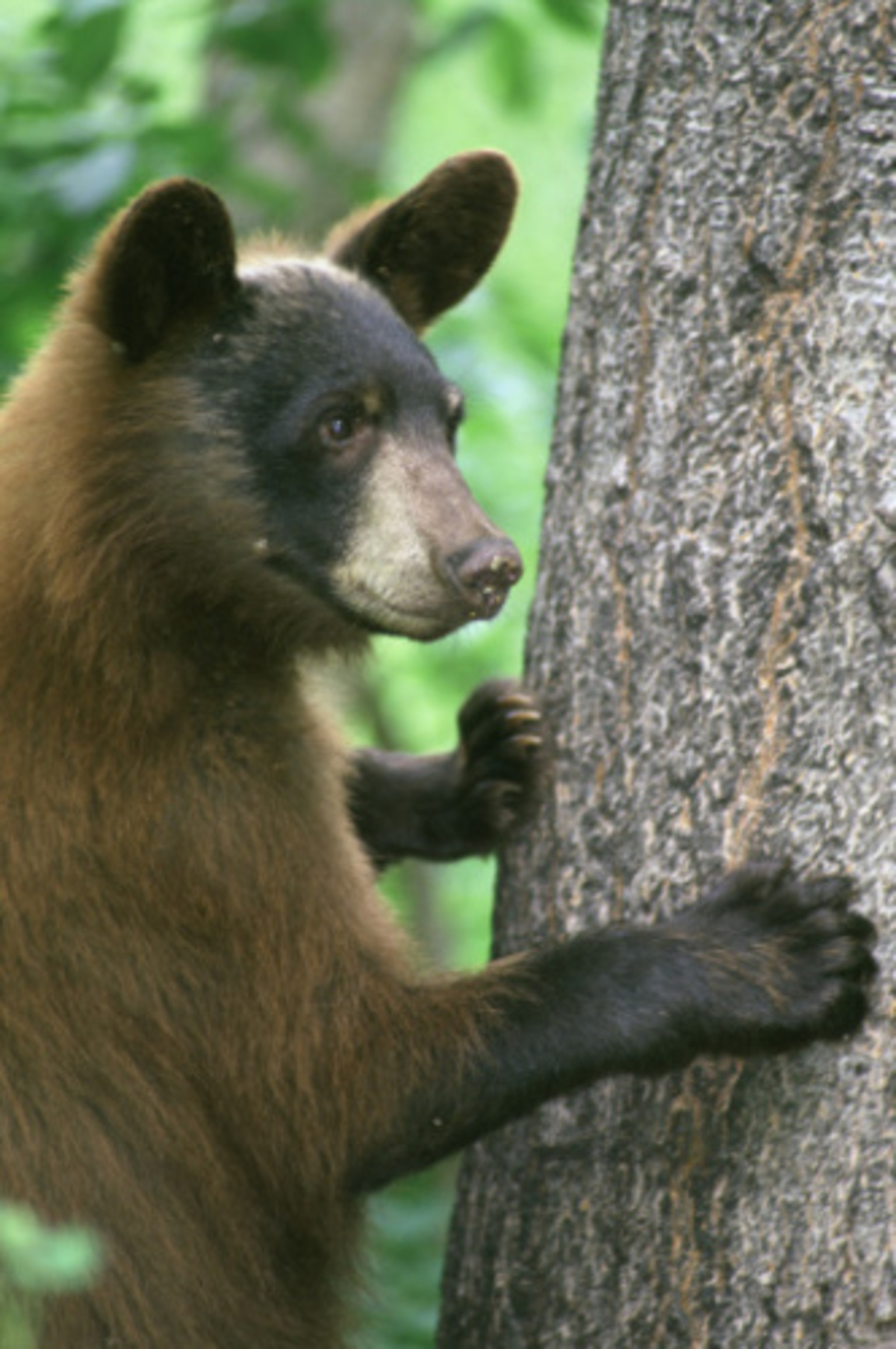
Featured photo: U.S. Forest Service, public domain. Photos illustrate the species and do not depict incidents in the supplied New Hampshire records.